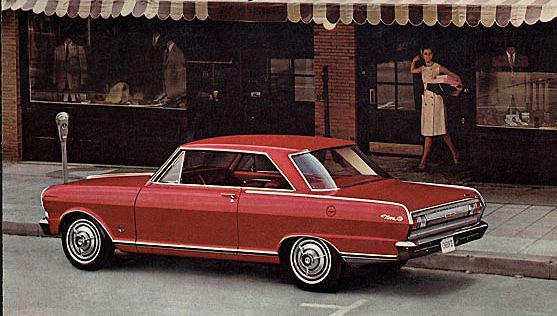
1962 thru 1963
The popular Chevrolet Nova was introduced as the Chevy II in 1961 as a 1962 model. It offered buyers a third choice in terms of size, standing between the (then) compact Corvair and the full size Chevrolet. The plans for the Chevy II began in December of 1959 with the code name H-35. The Chevy II was designed as a relatively plain intermediate "economy" car powered by four and six cylinder engines, to steal sales away from the popular Ford Falcon. Production began in August of 1961 and as the Chevy II gradually became available with many engine, trim, and convenience options, it joined in the performance ranks of the mid-60's as an inexpensive musclecar. The 153-ci 4-cyl and the 194-ci 6-cyl were all new engines when the Nova debuted on September 29, 1961. It was the first car to offer a Chevrolet 4-cylinder engine since 1928. That engine would later be used as a base for the development of GM's 4-cylinder sub-compact engines of the late 70's and 80's.
A strong following had been generated by Chevy's diminutive compact since its introduction in 1962, thanks, in no small part, to its sensible size and sporty appeal. But while the rest of the Chevy lineup was intoxicated by the heady horsepower generated from big blocks, the Nova maintained its compact car status and plucked its performance from the 153-ci in-line 4-cyl and the 194-ci straight-6.
A Super Sport option (RPO-Z03) first became available on the Chevy II Nova 400 line in 1963. This was the only year that Chevrolet built a "drop-top" Nova SS because it discontinued the convertible body style on Novas in 1964. This made the 1963 convertible SS one of the most valuable Novas, even though it only came with the 194-ci 6 cylinder.
1964 thru 1965
With the introduction of the factory-installed, 195 and 220 horsepower 283 small blocks (L32 and L77) in 1964, the 2,500 pound Nova began taking on the image of a real musclecar. The Nova was the willing recipient of an even larger infusion of horsepower in 1965. The 327 was deemed as an acceptable means of motivation for the Nova and was added to the option list. Both the 250 and 300 horsepower variants (L30 and L74 respectively) could be specified on the order form, and when coupled to the optional close-ratio four-speed and a set of 3.36 gears, the Nova was an unpleasant surprise for many unsuspecting stoplight bandits. The 1965 Nova was significant for many reasons. Not only was it the first year for the 327 cid engine but is was the only year a Powerglide transmission could be ordered with a high performance 327. It was also the first year for the twelve-bolt posi rear, an in-dash tachometer, and a FM band radio.
Still available on the last of the first-generation Novas, the Super Sport package remained virtually unchanged from the preceding years. Bucket seats, a floor shift and a console were expected ingredients included in the SS package, as were the Nova SS badges on the quarters and rear cove area. A slight restyling put the turn signals in the front bumper rather than in the grille, while out back a new taillight treatment could be found. As a true performance platform, the Nova was finally beginning to come around.
1966
Hot on the heels of the newly restyled Chevelle came the Chevy II Nova. It, too, underwent a complete restyling in 1966 into what many Nova aficionados consider the most desirable example of the marquee. The new Nova Super Sport was available with the economical six cylinder, or myriad mouse-motor derivatives, but clearly the hot ticket was the L79 version of the 327.
Rated at 350 horsepower, this mighty mouse sported factory hardware that rivaled even the best stuff down at the local speed parts emporium. Forged high-compression pistons, a performance-profile camshaft, big-valve heads, and an aluminum intake mounting a four-barrel Holley comprised the basis of this tarmac terror. Chrome engine accents finished off the package, including the valve covers, oil filler and cap, and the unique dual opposing-snorkel air cleaner. When strapped into a lightweight package like the Nova (less than 3000 pounds, ready to run!), well, you don't need much imagination to figure out the rest. Out of the box, the L79 was good for a 15-second quarter at about 95 mph. With a few judicious tuning tricks, headers, and some much needed slicks, even a novice could click off 13's without much difficulty.
Of the 172,485 Chevy IIs sold during 1966, the Nova Super Sport accounted for 20,986 units. It was also one of the most subtle of the super-cars. There was little to differentiate the SS version from its more sedate siblings, save for a few innocuous emblems found on the grille, rear cove and both flanks. And unlike the Chevelle's unmistakable big-block flags, the Nova's engine emblems weren't giving anything away either; they looked just like the small-block emblems found on Caprices. In fact, because they appeared so harmless, a favorite pastime of many Nova owners was to troll for the unsuspecting on their favorite cruise circuit. Once the hook was set, it took some pretty serious horsepower to put away the L79 Nova. With 5,481 Novas built in 1966 utilizing the mighty mouse L79, Chevrolet's street supremacy was matched only by that of their showrooms.
1967
Very few changes were implemented on the 1967 Nova, both physically and mechanically. After all, why mess with a good thing? An almost indiscernible grille change was the main external difference between the 1966 and 1967, while on the interior a new pattern was used on the seat covers along with a contrasting color stripe centered in each seat.
Under the hood, things weren't quite as bright as they'd been in the preceding year. The dealer ordering guides listed the 275-horsepower (L30) 327 as the top engine option, although Chevrolet production data indicates there were a total of six 1967 Novas built with the L79 variant of the 327, cranking out 325 horsepower. Four-speed transmissions were still a popular option for the sporty compact and 6,058 M20 wide-ratio gearboxes were installed at the owners request. Oddly, only two close-ratio M21 four-speeds found a home beneath the floorboards of the 1967 Nova.
The total production run of 1967 Novas was 106,430 with 10,069 of them bearing the Super Sport option. Most Nova Super Sports (8,213) were fitted with small-blocks, but 1,856 supported six-cylinders under their hoods. Seldom seen options include the A81 Astro-bucket head restraints (198 total), the J52 disc brakes (565 total), the N34 sport steering wheel (386 total), and the U15 speed warning (415 total).
There was a little known recall in 1972 for all 1965 thru 1967 V8 equipped Novas. Recall #70C10: Engine Torque Limiting Cable and Bracket Assembly. It's two cables that are bolted from the front cross member to the front of the engine block on each side. These were installed because too many Novas were breaking their engine mounts causing the engine to torque over too much and create an uncontrollable acceleration. (Thanks go to Stephen McNabb for informing me about this recall.
While it was only produced for two years, the 1966-1967 Nova is certainly one of the cleanest, most collectible Chevys of all time. And with the right engine combination, it was one small-block musclecar that cooked as good as it looked!
1968
While the first two generations Novas were genuinely nice cars with their clean, crisp styling (not to mention the incredible performance they had when fitted with the L79 350 horsepower, 327 incher), they were still, well, pedantic transportation devices. All that changed, however, with the introduction of the 1968 Nova. Conforming with the popular muscle machine formula of a relatively long hood and a short rear deck, the 1968 Nova launched itself right into the hearts (and garages) of those who wanted a subtle, yet effective street stomper. Small SS badges on the grille and between the rear taillights were the only tips that this was anything but granny's grocery getter.
The baddest of the bad were those who opened their eyes (and wallets) for the right option boxes. The 1968 Nova was the first of its kind to receive an infusion of big-block power. And, in order to ensure that you got what you wanted, you had to walk the salesmen through the ordering process. The big-block Nova simply was not a well-known option and early in the model year was not even included on the salesman's order forms. If you had the patience and perseverance, however, as well as the right option codes, you could be the first on your block to have one of these boulevard burners parked in your driveway. Only two big blocks were assigned to the Nova - the L34 350 horsepower (234 built), and the L78 375 horsepower (667 built). Because of their obvious rarity, they are both highly sought after today by Nova aficionados.
The L78 was doing well in the NHRA manual stock classes since its introduction in April of 1968. Fred Gibb was a drag racer and Chevrolet dealership owner so he convinced Chevrolet performance engineer Vince Piggins to install the TH400 automatic transmission in L78 Novas so they could compete in the NHRA automatic classes also. NHRA required at least 50 cars be built and available to the general public before they would recognize them as stock for the automatic class. The 50 L78's with the TH400 (COPO 9738) were built during the first two weeks of July 1968 and delivered to Gibb's Chevrolet dealership in LaHarpe, IL, on or before July 15, 1968.
If you weren't convinced that a big engine in a compact car was the way to go, you could opt for the 350, rated at 295 horsepower for 1968. Talk about your ultimate sleeper, this one could be delivered sans and performance emblems! Still, it could be ordered with any transmission, including the M22 four-speed, and any final drive ratio on the options list. It found favor with a total of 1,274 mouse motor maniacs who obviously believed good things came in small packages.
Just as Ford created the Mustang in 1964 from its intermediate Falcon, Chevrolet used the upcoming redesign of its intermediate as the basis for its own pony-car in 1967, the Camaro. While many say the 1968 and later Novas were just Camaros with a trunk and seating for five, the platform was actually designed first for the Nova and then quickly introduced in 1967 as the Camaro to catch up with the Mustang. From there, the Nova and Camaro would follow a similar evolutionary path, in terms of suspension and engine availability, until the Novas demise after 1979.
NHRA: 50th L78 Built - NHRA: 50 Automatic L78's Built
Thanks to Ray Morrison for providing me the above documents.
1969
There's a lot to be said for the old adage "don't mess with a good thing," and apparently Chevrolet agreed with that philosophy when they brought out the 1969 Nova. Visually, there was little to distinguish the newest Nova from the previous year's offering. But then, the 1968 Nova was a totally new package from the ground up. Perhaps the biggest changes came in the areas of safety and security, with power disc brakes being included as an integral part of the Nova Super Sport package while an ignition/steering column interlock made its debut as a theft deterrent. In fact, the locking column was standard equipment on all 1969 Chevrolets except the Corvair.
Powering the base 1969 Nova Super Sport was a 300 horsepower 350 incher (up five horsepower over the previous year) that could be had for the first time with a three-speed Turbo Hydromatic transmission. The 350 was revised internally, too, with stronger main bearing bulkheads and caps that were retained with four bolts rather than two.
As a street sleeper, the Nova SS was, without a doubt, the quintessential Q-ship. The usual gee-gaws that alerted everyone to the presence of a muscle machine were conspicuously absent. It was a combination that worked well. Especially when your Nova was fitted with the potent L78 engine. News of the L78 Nova combination traveled fast amongst the street savvy Bow-Tie believers, and production was way up over the previous year with 5,262 of them being unleashed on the otherwise unsuspecting public. Road tests of the L78 Nova showed it had the right stuff for doing battle on the boulevards. Even with skimpy E-70 tires and a 3.55 gear, mid 14's at more than 101 mph were easily attainable. Some tuning, headers, a 4.10 gear and more tire would put the Nova in the mid to low 13's.
For the Nova owner who liked the eyeball-flattening torque of a big-block, but didn't want to hassle with adjusting the solid lifters after changing plugs regularly to maintain optimum performance, there was another "not quite so nasty" Nova available. This one, equipped with the 350 horsepower version of the 396, was much more docile in day to day driving but could still take care of most stoplight encounters. Most Nova owners who wanted big-blocks under the hoods of their Super Sports preferred the max-output version, however, and only 1,947 of the tamer version were built.
1970
Nova fans are sure to lament 1970 as the last year for the Rat-engined compact. When it came time to appease the ever-tightening requirements of the insurance companies and government horsepower Gestapo, the Nova was the first on the chopping block. Even so, its final year with big-block motivation under the hood is one to be well remembered.
The big-block was certainly nothing new to the Nova lineup, having been introduced as a factory option when Chevy brought out the current body style on 1968. The hot setup was the L78 version of the 396, churning out 375 very strong horses. Now in its third year of production, the L78 Nova wasn't the well-kept secret that it once was and each passing year saw it produced in more prolific numbers. As in previous years, the hottest 396 outnumbered the still respectable 350 horsepower version, and in 1970 it accounted for 3,765 units compared to 1,802 Novas delivered with the "smaller" of the two big-blocks.
Mechanically, the L78 engine remained much the same as in the previous years, the only exceptions being an slight overbore (to actually displace 402 cubic inches) and a new intake manifold. While it still mounted a Holley carb, the intake was reconfigured to clear lowered hood lines on other Chevrolet models. And while the Nova still had more than adequate hood clearance, the smog certification for the L78 was completed with the new "low-rise" intake in place. Of course, the base powerplant for the SS Nova was a very capable 300 horsepower 350 small-block, especially when you consider its 3300 pound weight. In stock form, the SS 350 Nova was good for respectable 15 second clockings while the 375 horsepower big-block version was coaxed into the 13's quite easily.
Anyone but the most ardent Nova fancier would have an extremely difficult time discerning between the 1969 and 1970 versions; a slight taillight revision (larger lenses with the backup lamp moved to the middle of the lens) is probably the most evident clue. Super Sport insignia was still found on both the grille and rear cove areas (along with a blacked-out treatment), but that's about it. The downplayed visuals made the Nova a sleeper in the truest sense of the word and undoubtedly account for its popularity amongst the serious street runners. But they would have to find a new favorite for the coming year; the big-block Nova would be out of the performance picture for 1971. In fact, 1971 would bring about some tremendous changes for the performance enthusiast - none of them for the better. Unquestionably, 1970 will forever be regarded as the high point of Nova (and Chevrolet) performance.
1971
The Nova gave up a tremendous part of its performance value in 1971 when the big block disappeared completely from its list of available power-plants. Even in the smog-laden, low-compression form, big-blocks were still a part of the picture for the Chevelle and Camaro lineups. But tightening emissions and a decreased demand spelled doom for the Rat-engined Nova, much to the chagrin of Deuce lovers everywhere. If factory-built, Bow-Tie performance was what you were after, your time was better spent looking in other areas. Of course, that's not to say that the 1971 Nova was an incapable performer.
With a Q-jet fed 350 as its means of motivation, a 1971 Nova SS could click off low 15 second clockings at about 89 mph. With a few standard hop-up procedures, the Nova SS could start to deliver on its performance promise, and the ET could drop to mid 14's at speeds over 94 mph without sacrificing reliability or raising compression above its normal 8.5:1 ratio. Transmission availability for the SS was somewhat restricted; a decision had to be made between a wide-ratio four-speed or the Turbo 350 automatic.
Like the Camaro, the 1971 Nova was virtually indistinguishable from its immediate predecessor. Perhaps the most easily discernible difference was the lack of front fender louvers. Super Sport medallions could still be found in the grille and rear cove areas, both of which received the blacked-out treatment. Further proof that performance was becoming less important was evidenced by the fact that the bright engine trim, previously included as part of the SS package, was conspicuously absent. And while disc brakes remained a part of the SS package, the vented rally wheels that accompanied them were also relegated to optional status. The base wheel became a 7x14-inch steel unit sporting what was essentially a "baby moon" hubcap with the Chevrolet Bow-Tie embossed in its center.
Not surprisingly, sales of the sporty Nova also dropped off in 1971. There were a total of only 7,015 Super Sport Novas constructed during the model year, a sizable drop from the previous year's sales of 19,558 Nova SS's.
As an addendum to the Nova lineup, the Rally Nova (RPO-YF1) was created in 1971. This pseudo-musclecar featured a special striping package, blacked-out grille, rally wheels, and a sport mirror as the visuals, while any engine available for the rest of the Nova line could also be specified. 7,700 Rally Novas were built to meet the demands of buyers who wanted the appearance of a muscle machine without the insurance hassles usually attached to one.
1972
Unquestionably, the third generation Nova had secured a spot in the hearts of street savvy runners, particularly those with a penchant for going fast without looking the part. As a consequence, it also secured a spot on the Chevrolet hit parade as its popularity was reflected in sales figures. The restyled Nova, which made its debut in 1968, was a handsome package, to be sure. The boxy lines of its predecessors were exchanged for a more fluid, muscular design, and the "new" Nova was and instant hit. Especially when it was fitted with big-block motivation.
But the factory-installed big-block Nova had its last gasp in 1970. Despite it small-block power, the popularity of the Nova Super Sport continued into 1972, without major revisions - stylistically or under the hood. In fact, the demand for Nova Super Sports gained momentum as a total of 12,309 were built in 1972 compared to 7,015 in 1971.
The 1972 Nova SS could be had with only one engine, although buyers could specify either a three-speed automatic or a four-speed manual transmission to back it up. The engine was the L48 small-block, displacing 350 cubic inches and fed through a single four-barrel carburetor. Its horsepower rating was pegged at 200 (net horsepower figures were now used). This was good enough for 15.4 quarter mile ET's with a trap speed of over 88 mph. A unique option was added to the Nova line midway through the production year - a sliding fabric sunroof known as the Skyroof. Officially called the Ventura II Folding Sunroof, it was installed on 6,822 Novas in 1972. Each color carried it's own RPO code: White (RPO-WV1), Black (RPO-WV2), Blue (RPO-WV4), Pewter (RPO-WV5), Covert (RPO-WV7), Tan (RPO-WV9) and Green (RPO-YH8). The Rally Nova continued production in 1972 with a total of 33,319 built.
1973
The Nova received a minor appearance change in 1973. The rear side windows were enlarged, larger front and rear bumpers were government mandated, and new grill and tail lights freshened-up the look of the Nova. The door vent windows disappeared and a new three-door hatchback body style was introduced. The Nova Custom was the new top-of-the-line body style in 1973 and the Rally Nova was dropped. The SS option was now available with any engine, even the 6 cylinder. The package included a bold side stripe and a blacked-out grille and tail light panel. The Skyroof option was still available but this was the last year. 3,259 Skyroof Novas were built for the 1973 model year built unlike the previous year, all colors carried the same RPO code (RPO-CF1).
1974
The Nova remained generally the same for the 1974 model year except for slight revisions to the front and rear bumpers. The SS option was slightly revised with new stripes now on the hood and trunk. The tail light panel was no longer painted black but the window frames and sport mirrors were. In celebration of the upcoming bicentennial, Chevrolet created the Spirit of America Nova (RPO-Z51). This one-year option included special red, white and blue trim, stripes, and interior. There were 14,463 Spirit of America Novas built.
1975
The 1975 Nova had undergone a complete change in sheet metal along with some technical refinements in the frame, front suspension, and brakes. Also new for 1975 was the 4.3 liter 262 V8 engine, a catalytic converter was added to reduce exhaust emissions, electronic ignition, mandatory use of unleaded fuel on all engines, standard front disc brakes and steel belted radial tires on all models. The Nova Custom remained as an upscale version of the Nova but the new top-of-the-line package was the LN (RPO-Z11) which stood for Luxury Nova. The hatchback also continued with the new body
1976
Both the 262 V8 and the LN only lasted one year. They were replaced in 1976 with the new 5.0 liter 305 V8 and the Concours respectively. 1976 was the last year of the SS and it was not much more than special badges and a stripe kit option that could be ordered with any engine including the 250 base six. The SS did, however, receive a new diamond pattern grille with clear, horizontal turn signals. To commemorate the Olympic games in 1976, Chevrolet created the "Gold Medalist" Nova (RPO-Z78). It included special gold paint (paint code 53) and "Gold Medalist" emblems. While there are no specific numbers for the Medalist package, there were 5,489 Novas built with this special gold paint.
Another interesting package for 1976 was the Nova Shark. Little information about this car has been made available but rumor has it that it was a Chicago area dealer option in conjunction with the release of the movie "JAWS". Other rumors say only 300 were produced and they had rear disc brakes.
1977 thru 1979
While the Nova SS name was dropped for the 1977 model year, the Z26 package continued as the Nova Rally. It kept the diamond pattern grille, but received a different, three bar stripe. The Nova Custom name was also brought back to replace the Concours. All 1977 Novas received a new instrument cluster and dashboard and in 1978 they got a new steering wheel. The other changes to the 1977-79 Nova line consist of refinements rather than great technical changes. The only visual change was in 1979 when the Nova was given squared headlights. The Nova Rally continued for 1979 but it lost the diamond pattern grille. The last Nova built rolled off the assembly line on December 22, 1978.
The last generation Novas (1975 thru 1979) have long been in the shadows of its more popular older brothers, the 1962 thru 1967 Novas and the 1968 thru 1974 Novas. Although the "Late Model Box Novas" were built long after the government and insurance companies killed the performance musclecars of the late 60's and early 70's, they are no less impressive. Mark my words, these Novas will become more popular as older Novas get harder and harder to find. With standard disc brakes, a refined chassis and front suspension, and cheap prices, these Novas make a great foundation for some mean street machines. |
| Dealer-Prepped Deuces
It didn't take hot rodders very long to stuff a potent small block between the fenders of the first-generation Chevy IIs. In fact, although it took Chevrolet until the third model year (1964) to add a V8 to the option list, racers and high-performance enthusiasts were shoehorning them in ever since the first car drove off the dealer's showroom floor.
When the 1968 model year rolled around, Nova fans were just getting used to the potent package produced by a powerful mouse motor residing in a 3000-pound car. The 350-horse L79 pushed more than a few Deuces to the winner's circle. Racers like Bill Thomas and Bill "Grumpy" Jenkins were quick to exploit the car's tremendous potential in stock configuration and went all-out in competition.
But the street scene was where the biggest action was - and there were a few dealers who capitalized on the Nova's success. Don Yenko, Nickey Chevrolet, Motion Performance and Dick Harrell Racing were all dealers who produced versions of the Nova that have gone on to become muscle-car legends.
For more information on these dealer build supercars, check out the official Yenko Registry. It includes information on all these dealers, not just Yenko.
Don Yenko
 Don Yenko was in the business of selling Chevrolets from his two dealerships in Pennsylvania, but he was a racer and a true performance guru at heart. Subsequently, when certain customers demanded a performance upgrade, Yenko would accommodate them right from his shop. In order to handle this end of the business, Yenko created Yenko Sports cars, which specialized in swapping powerful engines into lightweight performance cars such as the Corvair Stinger, 427-powered Camaro and Chevelle and the Yenko Nova and Deuce. Don Yenko was in the business of selling Chevrolets from his two dealerships in Pennsylvania, but he was a racer and a true performance guru at heart. Subsequently, when certain customers demanded a performance upgrade, Yenko would accommodate them right from his shop. In order to handle this end of the business, Yenko created Yenko Sports cars, which specialized in swapping powerful engines into lightweight performance cars such as the Corvair Stinger, 427-powered Camaro and Chevelle and the Yenko Nova and Deuce.
 The Yenko big-block Nova was Produced in 1969 and the small-block-inspired Deuce debuted in 1970. The first-year Yenko's numbered 37, of which 28 had a 427 installed by Yenko's crew and 9 left the lot with the factory-installed 375-horse 396 powerplant. According to Yenko, the L72 427-powered Novas were the wildest cars he ever built. They were 396 cars with no SS emblems - and with the right tires and suspension setup, the finished machine was capable of reaching 60 mph in less than four seconds. The Yenko big-block Nova was Produced in 1969 and the small-block-inspired Deuce debuted in 1970. The first-year Yenko's numbered 37, of which 28 had a 427 installed by Yenko's crew and 9 left the lot with the factory-installed 375-horse 396 powerplant. According to Yenko, the L72 427-powered Novas were the wildest cars he ever built. They were 396 cars with no SS emblems - and with the right tires and suspension setup, the finished machine was capable of reaching 60 mph in less than four seconds.
 The 1970 Yenko Deuce was built, as Yenko put it, "as an insurance beater." Since legislation and the insurance industry were clamping down hard on overpowered street cars, Yenko decided to install a Camaro Z28 LT1 with 360 houses, solid-lifter cam, 12-bolt rear with 4.10:1 Positraction, F-41 suspension and a choice of manual or automatic transmission. 175 versions of the Deuce were built under COPO 9010 and offered in one of eight unique colors. Each car came stock with standard-grade black interior and a front bench seat. The 1970 Yenko Deuce was built, as Yenko put it, "as an insurance beater." Since legislation and the insurance industry were clamping down hard on overpowered street cars, Yenko decided to install a Camaro Z28 LT1 with 360 houses, solid-lifter cam, 12-bolt rear with 4.10:1 Positraction, F-41 suspension and a choice of manual or automatic transmission. 175 versions of the Deuce were built under COPO 9010 and offered in one of eight unique colors. Each car came stock with standard-grade black interior and a front bench seat.
Dick Harrell
 While Yenko machines are arguably the most popular of the Nova supercar clan, the rarest Nova muscle cars are probably those prepped by drag racer Dick Harrell. It is believed that only 15-25 SS 427-powered 1968 Novas were sold by Harrell through a network of Chevrolet dealerships, each of which included a full limited warranty. Harrell was friends with high-powered Chevrolet dealer Fred Gibb and used COPO cars ordered by Gibb as the basis for the Novas he created at his high-performance center. Once completed, they were delivered to a dealer for the customer to pick up. Like the Yenko's, Harrell's Deuce received a complete makeover, which included a 450-house 427 big-block, fiberglass hood, rally wheels, Positraction rear end, underdash gauges and a competition-built automatic transmission. The cars also came with Jardine headers, 6.5 inch wide M&H slicks and traction bars. For $4,412, you could buy a car that stopped the timers in 12.05 seconds at more than 115 mph in the quarter. While Yenko machines are arguably the most popular of the Nova supercar clan, the rarest Nova muscle cars are probably those prepped by drag racer Dick Harrell. It is believed that only 15-25 SS 427-powered 1968 Novas were sold by Harrell through a network of Chevrolet dealerships, each of which included a full limited warranty. Harrell was friends with high-powered Chevrolet dealer Fred Gibb and used COPO cars ordered by Gibb as the basis for the Novas he created at his high-performance center. Once completed, they were delivered to a dealer for the customer to pick up. Like the Yenko's, Harrell's Deuce received a complete makeover, which included a 450-house 427 big-block, fiberglass hood, rally wheels, Positraction rear end, underdash gauges and a competition-built automatic transmission. The cars also came with Jardine headers, 6.5 inch wide M&H slicks and traction bars. For $4,412, you could buy a car that stopped the timers in 12.05 seconds at more than 115 mph in the quarter.
Fred Gibb was heavily involved in drag racing when the L78 Nova was introduced in April of 1968. The L78 was doing well in the NHRA manual stock classes, but Gibb convinced Chevrolet performance engineer Vince Piggins to install the TH400 automatic transmission in L78 Novas so they could compete in the NHRA automatic classes also. NHRA required at least 50 cars be built and available to the general public before they would recognize them as stock for the automatic class. The 50 L78's with the TH400 (COPO 9738) were built during the first two weeks of July 1968 and delivered to Gibb's Chevrolet dealership in LaHarpe, IL, on or before July 15, 1968.
For more information, check out Don Coffman's Dick Harrell Nova page and this Competition Plus article.
NHRA: 50th L78 Built - NHRA: 50 Automatic L78's Built
Thanks to Ray Morrison for providing me the above documents.
Baldwin/Motion Performance
 If Yenko cars were classics and Harrell cars rare, the ground-pounding, sidepipe-equipped machines produced by Joel Rosen of Motion Performance in conjunction with Baldwin Chevrolet were nothing short of awesome. For around $3,600, each model had the 396 engine removed and, in its place was stuffed a more potent 450-horse 427 Rat motor. It also was delivered with a Muncie close-ratio four speed, Positraction rear end with re-welded spring perches, wide F-70x14 tires, dual exhaust, SS 427 emblems, chrome valve covers and air cleaner, modified 7500 rpm ignition, heavy-duty radiator, power front disc brakes, full dyno tune and factory warranty. For a mere $1,200 more, there was a healthier version available that featured a 500-horse engine, Super-Bite suspension, a large three-barrel Holley carb and special aluminum intake manifold, modified Mallory ignition system, dual electric fuel pumps, tuned equal-length headers, fiberglass hood scoop, racing clutch and aluminum flywheel encased in a competition-approved scattershield. Needless to say, these cars were the epitome of street performance. Since Motion continued to sell cars when the 454 made its debut, there were a few 1971 Novas running around with the bigger Rat under the hood. If Yenko cars were classics and Harrell cars rare, the ground-pounding, sidepipe-equipped machines produced by Joel Rosen of Motion Performance in conjunction with Baldwin Chevrolet were nothing short of awesome. For around $3,600, each model had the 396 engine removed and, in its place was stuffed a more potent 450-horse 427 Rat motor. It also was delivered with a Muncie close-ratio four speed, Positraction rear end with re-welded spring perches, wide F-70x14 tires, dual exhaust, SS 427 emblems, chrome valve covers and air cleaner, modified 7500 rpm ignition, heavy-duty radiator, power front disc brakes, full dyno tune and factory warranty. For a mere $1,200 more, there was a healthier version available that featured a 500-horse engine, Super-Bite suspension, a large three-barrel Holley carb and special aluminum intake manifold, modified Mallory ignition system, dual electric fuel pumps, tuned equal-length headers, fiberglass hood scoop, racing clutch and aluminum flywheel encased in a competition-approved scattershield. Needless to say, these cars were the epitome of street performance. Since Motion continued to sell cars when the 454 made its debut, there were a few 1971 Novas running around with the bigger Rat under the hood.
Nickey Chevrolet
Nickey Chevrolet was by far the largest of the auto dealers involved in selling aftermarket performance cars during its heyday. In fact, if you wanted speed parts, you simply walked next door to Nickey's own speed shop. But, as is often the case with larger businesses, exact information is hard to come by regarding Nickey's potent lineup of Novas. It's certain, however, that the dealership produced 427-powered Novas prior to 1970 that were a handful on the street and at the track. But when legislation clamped down on dealer-built muscle cars, the gurus at Nickey Chevrolet simply conformed to the regulations and offered smog-legal LT1, L88 and 454-powered machines. The cars were essentially race cars laden with smog systems. Unfortunately, there are but a few true Nickey cars still running around the streets.
Today we can only look back in awe at the lever of performance these dealer-built, high-output Rat-motored beasts were churning out. The only question to ask is why more of these special cars weren't produced while it was still legal to do.
The 1963 Fastback Novas
 In 1963, Chevrolet created three fastback Novas for road race competition. The Novas were all convertibles pulled from the regular production line. They were then shipped to the Corvette plant for the addition of fiberglass parts. The doors, inner panels, front fenders, hood and both front and rear bumpers were all 'glass. The new roof and fastback was also made of fiberglass and bonded to the metal. The fastback covered what would have been the trunk lid and blocked all access to the trunk area from the outside. In 1963, Chevrolet created three fastback Novas for road race competition. The Novas were all convertibles pulled from the regular production line. They were then shipped to the Corvette plant for the addition of fiberglass parts. The doors, inner panels, front fenders, hood and both front and rear bumpers were all 'glass. The new roof and fastback was also made of fiberglass and bonded to the metal. The fastback covered what would have been the trunk lid and blocked all access to the trunk area from the outside.
 After a 1963 Corvette independent rear suspension was also added, the cars were shipped to Bill Thomas in California. Chevrolet also shipped the "Mystery Motors", that later ended up with Smokey Yunick, to Bill to be installed in the Novas. Bills job was to install the engines and setup the suspension for road racing. Before the Novas could be completed, GM put a ban on all factory racing. After a 1963 Corvette independent rear suspension was also added, the cars were shipped to Bill Thomas in California. Chevrolet also shipped the "Mystery Motors", that later ended up with Smokey Yunick, to Bill to be installed in the Novas. Bills job was to install the engines and setup the suspension for road racing. Before the Novas could be completed, GM put a ban on all factory racing.
 GM ordered the cars crushed but Bill worked out a deal to keep the cars as payment for his work. The engines were sent back to Chevrolet and then to Smokey Yunick in Florida. He then sold one Nova to Fritz Callier, a Chevrolet dealer in Dallas,to be drag raced. Another one was sold to a Los Angeles Chevrolet dealer who drag raced it for less than two months before crashing it and totally destroying it. The third was sold to Alan Green Chevrolet in Seattle. GM ordered the cars crushed but Bill worked out a deal to keep the cars as payment for his work. The engines were sent back to Chevrolet and then to Smokey Yunick in Florida. He then sold one Nova to Fritz Callier, a Chevrolet dealer in Dallas,to be drag raced. Another one was sold to a Los Angeles Chevrolet dealer who drag raced it for less than two months before crashing it and totally destroying it. The third was sold to Alan Green Chevrolet in Seattle.
 Alan Green also drag raced the Nova with driver Dick Milner and crew chief Tom Foster. Green, Milner and Foster raced the Nova at drag strips throughout the northwest United States and western Canada from 1963 until 1967. During one race the fastback roof blew off at 155 mph. The team then ventilated the rear section to keep the car from wanting to fly above 150 mph. Alan Green also drag raced the Nova with driver Dick Milner and crew chief Tom Foster. Green, Milner and Foster raced the Nova at drag strips throughout the northwest United States and western Canada from 1963 until 1967. During one race the fastback roof blew off at 155 mph. The team then ventilated the rear section to keep the car from wanting to fly above 150 mph.
These fastback Novas sport a roofline similar to, but predating, that of the Plymouth Barracuda, AMC Marlin, 1966 Dodge Charger and about half of the late-1960's-era Fords. Fastbacks were popular with buyers in the later 60's, but aerodynamic efficiency on the race track was the main concern of Chevrolet engineers. Ironically, even though they were built to be road raced, all three of the fastback Novas spent almost their entire racing lives on the drag strip.
The 1964 Super Nova Show Car
 The Super Nova show car made its debut at the New York Auto show in April of 1964, revealing the design ideas being kicked around for the upcoming Chevy II restyle. The Super Nova show car made its debut at the New York Auto show in April of 1964, revealing the design ideas being kicked around for the upcoming Chevy II restyle.  The proportions of the car anticipated the major styling themes that would become popular among youthful drivers in the mid '60s, specifically the longer hood and shorter deck. Chevy II script along the bottom of the front fender of this show piece indicates Chevrolet had a sportier future in mind for its compact economy car. This car was also used to create the Camaro. The proportions of the car anticipated the major styling themes that would become popular among youthful drivers in the mid '60s, specifically the longer hood and shorter deck. Chevy II script along the bottom of the front fender of this show piece indicates Chevrolet had a sportier future in mind for its compact economy car. This car was also used to create the Camaro.
For more information, check out Don Coffman's Super Nova show car page.
|
The above text consists of some original material and excerpts from the following sources:
|
Chilton's Repair & Tune-up Guide
Chevy II Nova 1962-79
Chilton Book Company, 1979
| "The Wonder Years"
Written by: Chuck Hanson
Super Chevy Magazine
May thru December, 1990
| Frank Incremona
Super Chevy Magazine
November/December, 1990
| "Nova SS"
Written by: Steve Statham
Muscle Car Color History
Motorbooks International, 1997
| Ray Morrison
An original owner of a
1968 Dick Harrell Nova
|
NOTE: The name Skyroof® is now a registered trademark of Donmar Enterprises, Inc. |